ExGen
Exploration Generation
The next mission
Science literacy and science engagement for the 21st century.
aSIMetric Inc.
Team building, seeking partnerships and funding

Why ExGen?
“If you want your students to build better ships, don't teach them carpentry, teach them to long for the open oceans.”
- Antoine de Saint-Exupéry
A note from the founder
I’m often asked how I survived the Darién Gap, the Bering Strait, and the frozen wastes of Alaska and Siberia. I point to three important factors: an unshakeable self-confidence, an overwhelming sense of mission, and an understanding of the world around me. Knowledge.
Read moreShow less
Sometimes, that knowledge will prove to be the difference between life and death. What is true for an individual is also true for a species. A species that does not understand the reality of its environment has a much lower probability of survival.
There were many things that might have kept me awake at night in that tent. The night terrors weren’t the storms or the things that slither and crawl. Personally, more often than not, it was Sagan’s The Demon-Haunted World: a civilization increasingly dependent on science and technology that repeatedly felt like it was coming off the rails—the fear was in watching the candle flicker erratically in the dark.
After nearly three decades of unwavering support from strangers of every culture and nation, I have rediscovered my faith in humanity. I have come to love the good people of Spaceship Earth. We are worth the fight. And so, as one long mission ends, another begins.
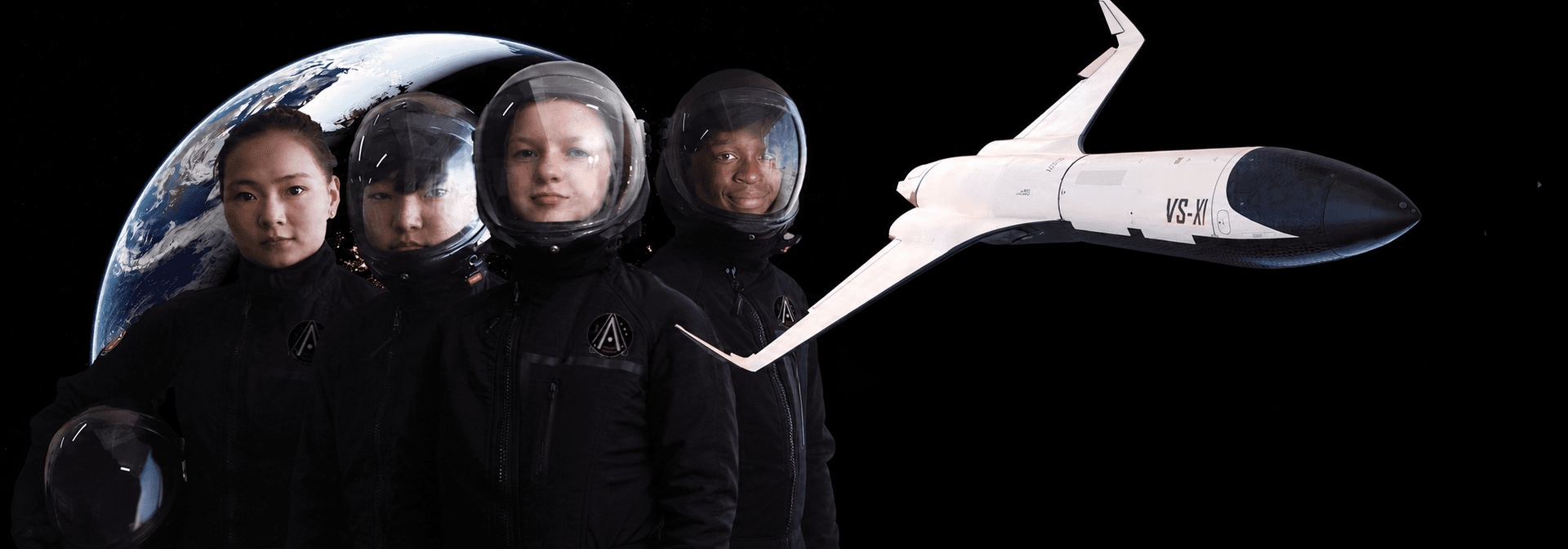
Humanity’s greatest journeys are close at hand. Our inherent drive to reach for horizons will give us a mission—a powerful narrative providing purpose and meaning. As if watching Polynesians gather ships in shallow waters, we watch humanity prepare to leave low Earth orbit, about to embark on our greatest voyages: to reach and settle distant worlds. Journeys destined to inspire millions of young minds.
aSIMetric intends to build the tools that capture that excitement—tools within which the young can dream of and enact journeys beyond their wildest imaginations. Give them the space and the means to act on those desires. Build dream machines—and build them to scale.
If you want a culture steeped in science literacy and science engagement, understand the essential importance of emotion in learning and the power of entertainment. Let them fall in love with the new oceans, the deep open skies, and distant points of light. The path to knowledge, and hence our survival, is woven through the dreams of our next generation. Reality has effectively done half the work for us. Our longing for the journey is built into our DNA, we just need to ride that wave. Give it a space to express itself.
Our job is to provide a compass point: a narrative with a sense of direction, a vision of a future worth learning for. In our new era of computational intelligence working might mean more human focused skills. The story tellers, game designers, explorers, world and dream scape builders, influencing and motivating civilisations.
Whatever you are doing in the 21st century, if you aim to make a difference, your product is culture.
Challenges
Mission
aSIMetric's explicit mission is to innovate creative solutions for a unique state of the art entertainment approach to an informal science engagement and learning strategy. Capable of being implemented as a capture strategy, targeting youth and public alike. aSIMetric is specifically targeting three key challenges consistently identified by professionals across education, industry, and government sectors:
Our approach was structured around three practical challenges facing science and STEM education, both formal and informal:
The need for greater emotional engagement.
The need to overcome 'single event exposure’ with long term engagement.
The need for greater accessibility with local affordable inspiring educational programs.
Our approach is best understood when viewed through the lens of the following quote. “When children are interested, education happens” - Arthur C. Clark
An aerospace culture
The path to inspired generations
Why now?
Aviation and space exploration inherently captivate the public's imagination, offering an unparalleled gateway to a vast array of STEM topics. Through aerospace simulation, we can transform abstract scientific concepts into tangible, physical experiences.
Read moreShow less
The future potential of space exploration, particularly its impact on youth, is often underestimated. The Space Race of the 1960s and 1970s, for example, ignited a massive educational boom in the United States. This era saw a threefold increase in STEM-related PhDs, not primarily due to educational policy, but because the public witnessed engineers dreaming, building, and achieving the seemingly impossible. People were profoundly inspired.
As humanity prepares to return to the Moon and venture into deep space, a new era of inspiration is dawning. We all stand to benefit significantly as these real-world events influence younger generations. The future will see a generation motivated and inspired. We need mature programs ready to accommodate and capture that potential.
With the advent of space tourism, the commercialization of space, and humanity's push beyond low Earth orbit, the next chapters in our history are rapidly approaching. Should we fail to have capable and mature capture strategies in place, waiting to accept the firestorm of enthusiasm that will follow, then we deserve the harshest judgment history will arrange.
Why Simulation?
This solution stems from the first of our three challenges; the need for more emotional engagement. No one engages young people better than game designers. Narrative, immersion, captivating a generations imagination, the game phenomena provides a very effective form of emotional engagement. This is critical. The future of education is better understanding the emotional bedrock that motivates learning.
Read moreShow less
aSIMetric’s entertainment-centric approach is designed to capture that initial interest. Children are tough customers, entertainment provides the competitive edge in a world competing for our children’s attention. We need a unique solution, with unique architecture, we need Decisive Impact And Emotional Engagement. To be able to compete, aSIMetric is engineering an immersive, high-fidelity aerospace simulation, combining aviation and space exploration into a single experience. A high-impact, engaging, and memorable informal learning experience. An experience designed to maximise emotional engagement. An engineered tool, using the well understood phenomena of entertainment, to broaden the catch net, and encourage more young people to engage.
The simulation
The ExGen experience
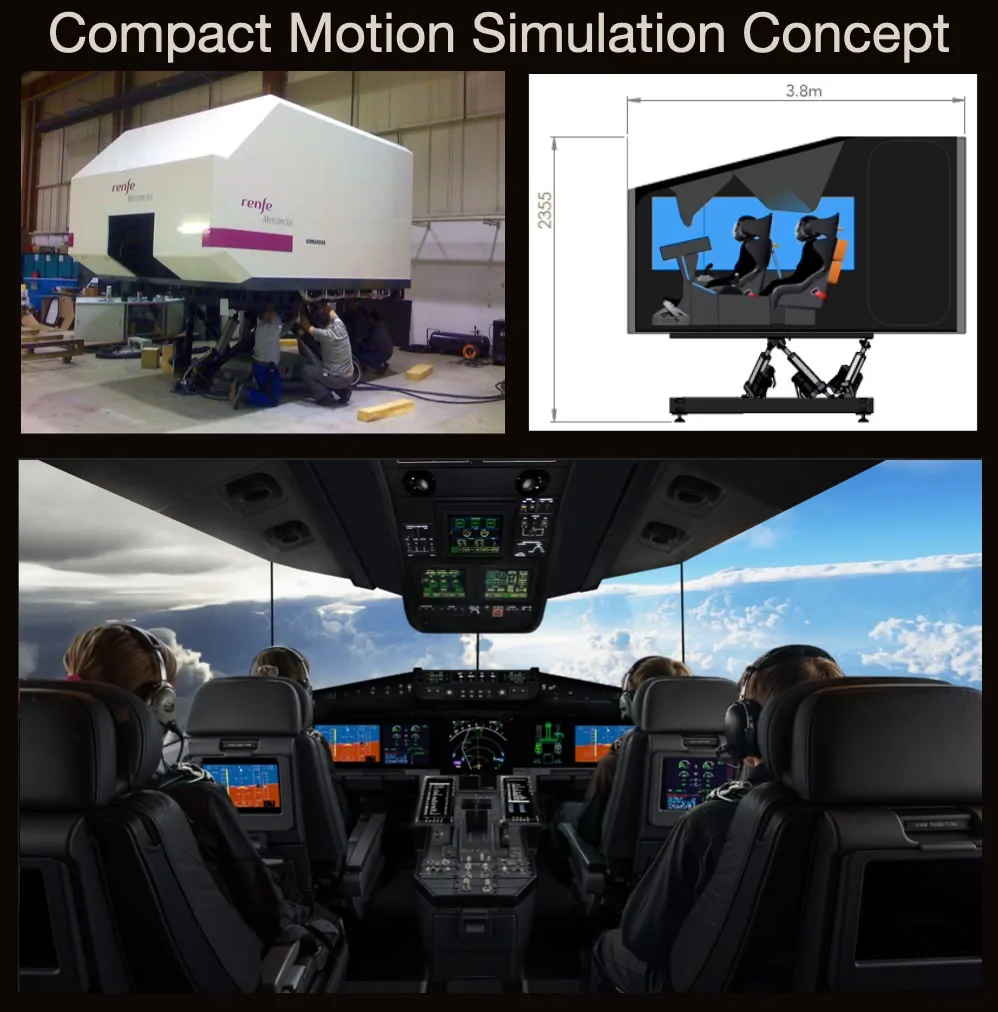
aSIMetric understands it is about the experience, an experience that is truly immersive. Sight, sound, touch and smell, in a fully immersive tactile and kinetic environment. This is collaboration between engineering and art. The hardware and corresponding software form the technical crux of the commercial program. The motion platform would be used to simulate both atmospheric flight and orbit, accentuating manoeuvres such as acceleration and deceleration. The next component to consider is the cabin and flight deck. Everything that happens, the entire mission architecture, has to happen from that flight deck. The internal environment requires a good level of fidelity to create a full, immersive, tactile experience; it needs to look, feel and sound as close to reality as possible. An experience made all the more meaningful, if we incorporate a social, or team based, design element. The simulator is built around a team, or flight crew, of four. This gives us a shared experience, between friends or family members. Unlike VR experiences designed around the individual, our classroom of the future is VR built around a team, with layers of immersion. An adventure played out in a virtual sandbox universe providing great depth, enabling long-term engagement, shaping virtual career options. A system that allows the team to write the story of how they, as a team of four friends, explored and conquered the universe. It is a narrative soaked in experience, lessons hard-learned, battles lost and won.
Read moreShow less
Instead of traditional, large-scale centralised institutions, we envision a compact, easily maintained, and cost-effective distributed system. This allows us to scale down on costly infrastructure while scaling up virtual, and interactive experiences. Our compact system can be deployed in various population centers, overcoming traditional barriers of travel and cost. This greatly increases accessibility for the public and children that often don’t get these opportunities. This shifts from the focus, of large informal STEM institution, from high passthrough, high-volume of visitors and "hope something sticks" approach, to a more focused, emotionally engaging strategy. Particularly well-suited for smaller population centers. Reduced passthrough, but with more impactful content, aSIMetric aims for a greater probability of meaningful engagement. Servicing numerous population centers with our flexible and versatile approach will ultimately lead to more effective distributed passthrough and greater cultural penetration over time.
This is also a solution to our second challenge: the phenomenon known as single event exposure. Children exposed to these programs and institutions indeed may experience an initial burst of inspiration from a program or visit. But without follow-up, this excitement quickly fades. Sustained interaction is crucial to nurture that initial spark into a lasting passion and cultivate lifelong learners.
Aerospace is the medium.Curiosity is the mission.
Explore a partnershipA Capture Strategy
Capture, Hold, Connect
- 01Capture
- 02Hold
- 03Connect
Aerospace provides a golden opportunity as a capture strategy. A Capture, Hold, Connect approach, reimagined for the 21st century, converting visitors into active participants, an important distinction. The 'capture' component is the entertainment interface with the public. Unlike most informal STEM programs like coding or robotics, aSIMetric leans in to entertainment to widen the catch net and not just preach to the fan base.
Read moreShow less
Hold, or nurture is the implementation of long-term programs leaning on narrative, long term distant goals, always just out of reach. A unique team based adventure to distant worlds and discoveries.
On the back end of our capture strategy are the ecosystems that dovetail with formal and informal education organizations across a given nation. aSIMetric is designed as both a capture strategy and a local STEAM education resource, requiring and facilitating broad community ecosystems. aSIMetric understands that quality science learning is best supported through a robust cohesive community-wide ecosystem. It is not a stand-alone program, gone are the days we work alone, the STEAM community is a team effort. It begins with inspiring, it grows with engagement, it persists with learning.
Classrooms Of The Future
Self-organizing learning environments
Inspired by Professor Sugata Mitra's 'Hole in the wall’ experiments, first carried out in 1999, and his teams work into SOLEs, Self-organizing learning environments. We understood self learning and discovery are powerful educational strategies.
Read moreShow less
Further studies, based on these surprising experiments, found that such self-learning principles, gave rise to deep learning. Those students invested in the experience, and the process of discovery, rather than being taught traditionally, showed the children retained the knowledge better. Follow on experiments concluded that there are many ways education can be effective, outside the state education system, and the importance of self-learning and self-organization can lead to emergent properties with very positive results.
Professor Mitra, later optimized classroom conditions, to encourage effective self-learning environments. Confirming that children in small groups, of four to six, proved optimal. This approach, produced what were referred to as SOLEs, Self-organizing learning environments. Many, such programs were established in classrooms around the world. However, these approaches are not easily applicable, to state school curriculums. As such, the concept was not widely adopted. It became clear, very quickly, the difficulty working with state education. This led to the aSIMetric team forming an informal educational program, as a nonprofit.
We view our flight decks and cabins as classrooms of the future. Many elements, of Professor Mitra’s work, played a prominent role, in shaping our ideas. New ways we might better engage children, with long-term, Informal entertainment-centric educational programs. We envision our simulated environments, optimised for a team of four students, as compact classrooms or SOLE’s.
Read. Listen. Watch
aSIMetric introduction
A 22-minute audio overview.
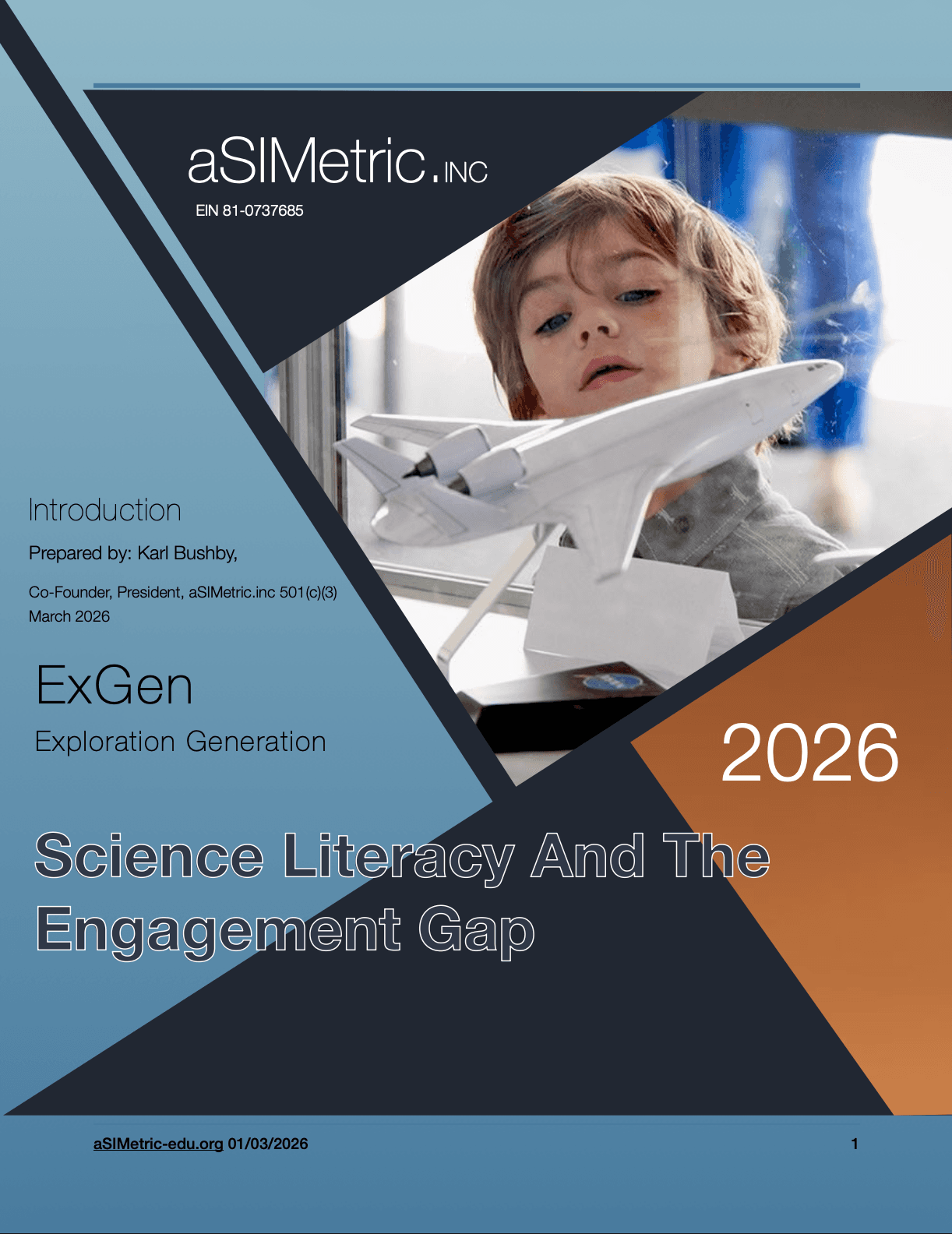 Read A Detailed Brochure
ExGen 2026 introduction
A visual overview of the science literacy and engagement gap.
Detailed brochure preview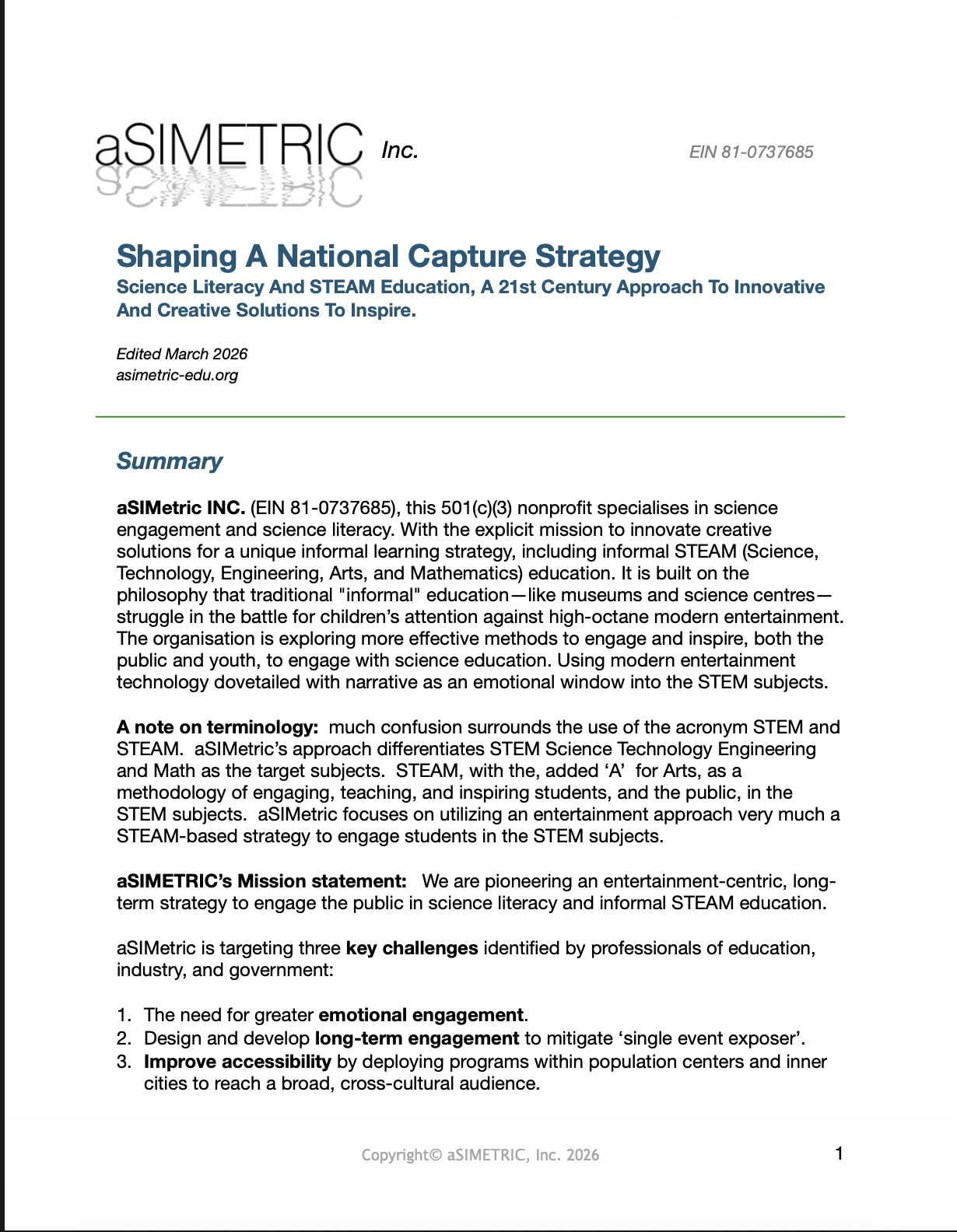 Read A Detailed Document
Who we are
The aSIMetric team
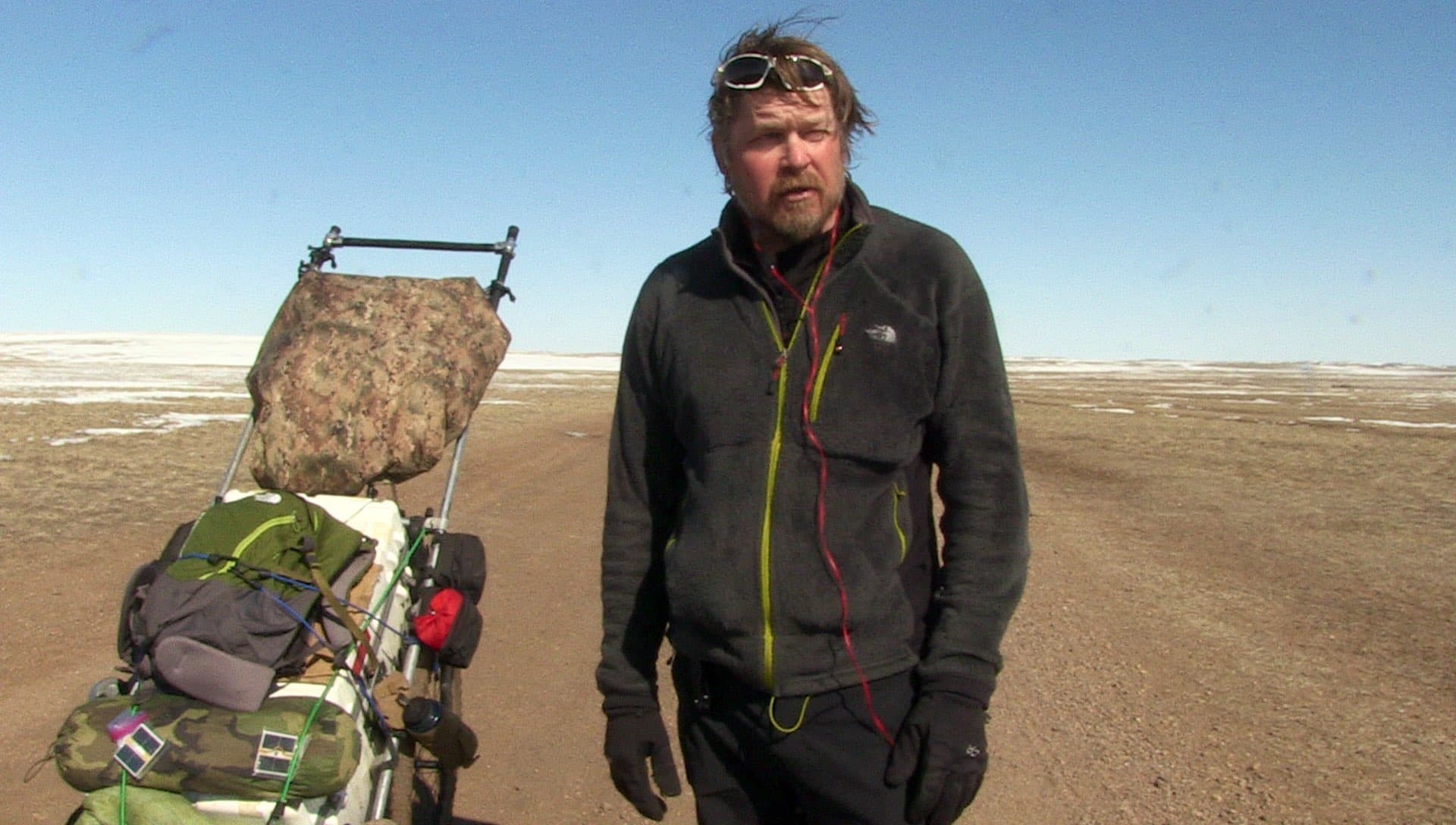
Karl Bushby (UK)
British ex-paratrooper turned adventurer and author. Two things keep him awake at night: strange noises in the forest and his concerns over scientific literacy. Not much to be done about the first, but scientific literacy has become his mission.
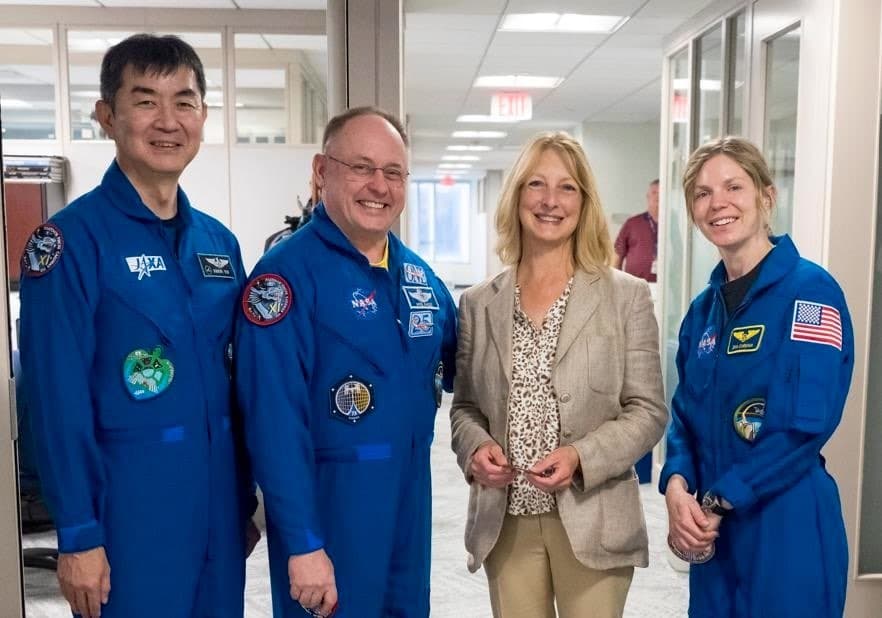
Mary Williams (USA)
NASA Human Spaceflight Mission Directorate Project Coordinator, former STEM educator and operations manager for a science center.
Help build the first platform
aSIMetric is team building, seeking partnerships and funding.